.png?width=919&height=338&name=BASEWISE.AI%20THEME%20(23).png "BASEWISE.AI THEME (23)")
The Case for AI‑Native Platforms in Future‑Proof Engineering Projects
By Danielle de Hoogh on Jan 14, 2026 7:01:37 PM
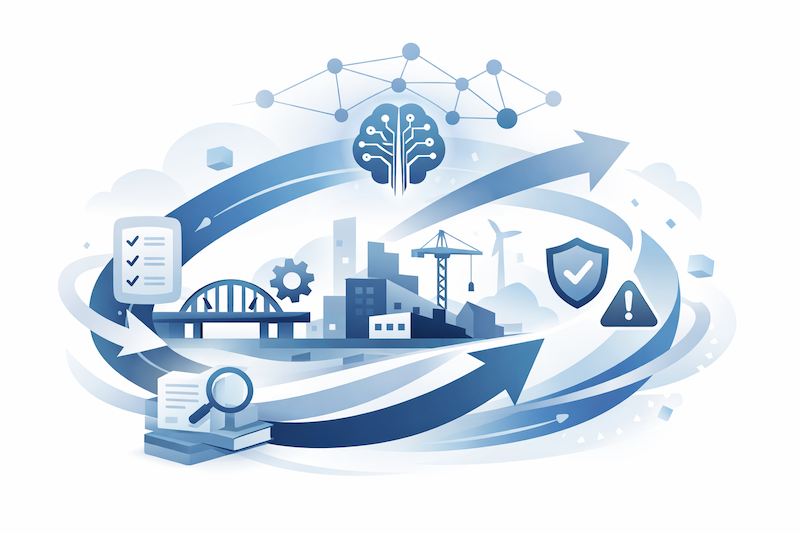
In 2026, the success of engineering and construction projects is defined not by the technology used, but by the speed of decision-making. As requirements shift and regulations tighten, traditional static planning is failing. AI-native platforms like Basewise are bridging this gap by transforming requirements from static documents into living system knowledge that reacts to change in real-time.
The high cost of rigid planning
Research into large-scale construction projects reveals that failures are often structural—rooted in the inability to adapt to design changes late in the lifecycle.
- 56.5% of cost overruns are driven directly by design changes.
- 40% of project delays stem from the inability to pivot when requirements shift.
- 60% higher performance in revenue and profit is seen in organizations that adopt dynamic planning cycles over traditional calendar-based ones.
Three essential pillars of AI-native success
Requirements as living system knowledge
In complex projects, gathering requirements is a continuous process, not a one-time event. AI-native platforms treat every requirement as a dynamic data point.
- Traceability: Every change—from a new safety standard to a supplier dropout—automatically updates all connected design choices.
- Proactive Steering: Instead of repairing designs after a conflict is found, teams can see exactly which verification activities need adjustment immediately.
- Risk Mitigation: Automated impact analysis ensures that no downstream effect is overlooked when a 'minor' change is made upstream.
Key advantages:
- Real-time impact: Instantly see how a changed functional requirement effects existing subsystems
- Automated verification: Updates testing and validation protocols as soon as requirements shift
Navigating the regulatory patchwork
The regulatory landscape for digital and physical systems (EU AI Act, GDPR, Data Act) is now too complex for manual management.AI-native platforms link laws, standards, and contracts directly to system designs. If a fire-safety standard is tightened mid-execution, the system automatically calculates which components are non-compliant and which partners must be alerted.
The compliance engine
Basewise and similar platforms handle Regulation EU 2024/1689 by:
- Conducting continuous risk assessments.
- Compiling technical documentation automatically.
- Ensuring human oversight through event-driven alerts.
From calendar-based to signal-driven
Traditional projects wait for 'phase gates' to make major decisions. In 2026, leading organizations use trigger-based decision-making.
- Assumption Checks: AI continuously monitors the project's foundational assumptions (e.g., material costs, environmental regs).
- Trigger Events: An unexpected delivery update or a safety alert acts as a 'signal' that prompts an immediate design or contract review.
- Competitive Edge: Leaders who revisit assumptions based on signals outperform competitors by significant margins in profit and agility.
1| Requirements and constraints change more often and later
That design changes are the biggest driver of cost overruns and delays is directly relevant to how engineering and construction projects operate. In complex projects, gathering and capturing requirements takes time; stakeholders change their minds, laws are tightened and suppliers drop out. A traditional documentation system cannot keep up with such dynamics. AI‑native platforms like Basewise treat requirements not as static documents but as living system knowledge. This means that whenever a change occurs — whether it is a new standard, an adjusted functional requirement or a contractual addition — the platform immediately shows which design choices are affected, which verification activities need to be adjusted and which risks need to be reassessed. The project team can thus steer in time rather than repair afterwards.
2| Regulation and compliance are growing more complex
The regulatory environment surrounding digitalisation, data and AI is becoming more varied and stringent. The World Economic Forum describes how the European Union and other power blocs pursue digital sovereignty through initiatives such as the Data Act, Data Governance Act, AI Act and GDPR, resulting in a complex, fragmented legislative context. The European AI regulation (Regulation EU 2024/1689) requires providers of AI systems to conduct thorough risk assessments, compile technical documentation, carry out conformity assessments and ensure human oversight. These obligations are not limited to software firms; manufacturers of machines, infrastructure and mechatronic systems fall under them as soon as they use AI. Managing compliance requirements therefore demands a system that links laws, standards, contracts and system designs. Basewise helps by automatically connecting regulatory and contractual obligations to systems and requirements. For example, if the fire-safety standard is tightened halfway through an execution phase, Basewise immediately calculates the impact: which components need to change, which risks are affected and which partners must be contacted. This prevents a tunnel from being completed only to discover at delivery that it does not meet the new standard.
3| From calendar-based decisions to signal-driven decisions
The Harvard Business Review study of 5 700 executives shows that organisations with dynamic planning cycles outperform competitors 60 % more often. The difference lies not in a grander vision, but in the frequency with which leaders revisit assumptions and adjust course. In engineering and construction projects, this means decisions are no longer made only at pre-planned phase gates; they are made whenever a relevant signal arises. Think of an unexpected delivery update on a critical component, a change in an environmental regulation or the emergence of a safety issue. AI‑native platforms can automatically pick up these signals and analyse them contextually, so the team immediately knows whether it makes sense to adjust a design or to modify the contract. This aligns with the broader trend towards trigger‑based decision-making highlighted by CIO surveys.
4| Practical case: how Basewise works in practice
Scenario: you are building a bridge and halfway through the execution phase the EU standard for steel structures is tightened, including stricter requirements for welds and material certificates. Traditionally this would lead to a construction stop and redesign. With Basewise the following occurs:
- The new standard is automatically detected in the compliance module.
- Basewise links the standard to all relevant requirements and subsystems and generates an impact analysis.
- The platform points out which welds in the design are affected, which material certificates are missing and which suppliers need to be contacted.
- An automated report is shared with the project manager and quality manager, including proposed adjustments and a recalculation of schedule and budget.
The team can thus decide on necessary changes within days and continue execution with minimal delay.
What sets Basewise apart
Unlike generic AI tools, Basewise packages its capabilities into a modular, secure platform built on the Microsoft stack, designed specifically for construction and systems‑engineering projects. The platform integrates seamlessly with existing IT landscapes and includes a dedicated AI chat assistant, enabling teams to summarise documents, compare bids and accelerate progress reports within a controlled environment. Basewise also offers a suite of standard AI applications—Document Requirements Extractor, Requirements Quality Analyser, Verification Planner and Evidence Finder—to automate the extraction, assessment and proof‑matching of requirements. Through agentic AI, the system links client specifications, design models and verification evidence, automatically identifies the impact of changes and generates structured impact reports, turning traceability and compliance into a proactive, continuous capability.
Conclusie
The figures leave little room for doubt: design changes are one of the biggest drivers of cost overruns and delays, regulation is becoming rapidly more complex and organisations with dynamic planning cycles achieve significantly better results. For engineering and construction companies, this means they must not only adjust their processes but also the tools they use. AI‑native platforms like Basewise transform requirements management, compliance and decision-making from a static, manual activity to a dynamic, integrated process. This allows organisations to not only meet increasingly strict standards, but also to increase the resilience and predictability of their projects.
References:
- Ramadhan, J. S. et al. Impact of Change Orders on Cost Overruns and Delays in Large‑Scale Construction Projects (Engineering, Technology & Applied Science Research, 2025).
- World Economic Forum. What is digital sovereignty and how are countries approaching it? (2025).
- Europese Unie. Regulation (EU) 2024/1689 Artificial Intelligence Act.
- Harvard Business Review. Adaptive Strategy in a Volatile World: Why Static Roadmaps Fail (Christina Aguilera, 2025)
You May Also Like
These Related Stories
-1.png)
We’re excited to announce a major update to our Document Requirements Extractor (DRE)
Why AI investments in requirements management