.png?width=919&height=338&name=BASEWISE.AI%20THEME%20(23).png "BASEWISE.AI THEME (23)")
By Christian van Eken on Nov 26, 2025 10:17:24 AM
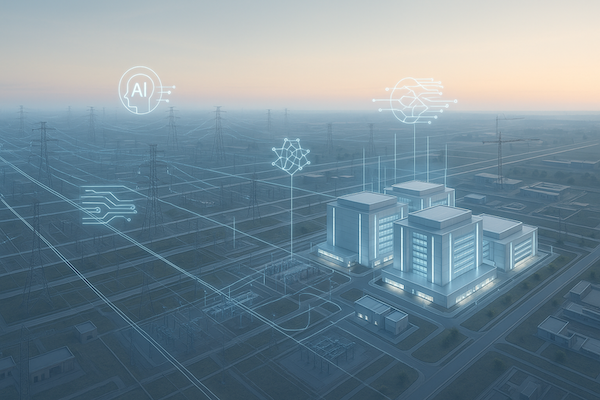
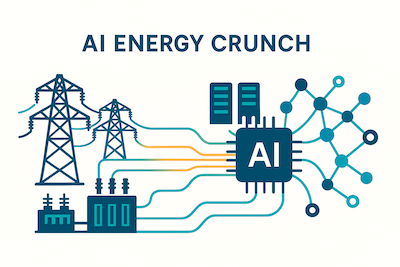
AI may still feel like “just software,” but its impact is brutally physical: power consumption, cables, transformers, substations, and grid capacity. While everyone is talking about generative AI, the real conversation happening among grid operators, asset owners, and project leads is very different:
“We simply can’t get connected anymore.”
This article explains what the AI energy crunch is, why it affects your projects, and—most importantly—what your organisation can do about it in practical terms. Written for decision-makers in construction, infrastructure, and energy.
01| So, what exactly is the ‘AI energy crunch’?
In short:
- AI is driving up the demand for computing power.
- That computing power lives in data centers, edge locations, industrial IT, and production environments.
- Data centers and electrification are putting increasing pressure on an already maxed-out grid.
- At the same time, customers, governments, and shareholders expect you to become more sustainable.
Source > IEA+1
McKinsey estimates that nearly $7 trillion in data center infrastructure will be needed globally by 2030 to keep up with demand for AI compute.
These are no longer just IT statistics
02| What has really changed since 2024–2025?
A few hard trends are converging:
Explosion in AI data centers
- Hyperscalers and cloud providers are rapidly building new AI-ready data centers.
- According to McKinsey, global data center capacity could triple by 2030, with a large portion of demand driven by AI.
- Deloitte projects that, in some scenarios, the energy consumption of AI data centers could be up to 30 times higher in 2035 than it is today. PR Newswire+1
Grid congestion and queues
- Across Europe, hundreds of gigawatts of renewable projects and industrial consumers are stuck in connection and expansion queues.
- In several countries, waiting times for a higher-capacity or new connection can stretch to many years. Eurelectric - Powering People+1
Electrification & climate targets
- At the same time, we are electrifying heat, mobility, and industry.
- Regulations and sustainability goals require both CO₂ reduction and increased digitalization.
Simply put: demand is rising more quickly than the grid or permitting processes can handle. AI is both a major driver of this challenge and an essential part of the solution.
03| The three key pain points project teams are facing today
Grid capacity: “the network can’t handle it”
You might hear: “Grid full.” “No transport capacity.” “We can’t review your request until 20XX.”
The immediate result: Projects that are technically, financially, and spatially ready come to a standstill because there’s no space left on the cables.
Permits & studies are slowing project timelines
- Grid studies, environmental impact assessments, cable routing, substations…
- Every stage comes with its own documentation and alignment requirements.
- The lead time for construction and infrastructure is often shorter than for securing the surrounding energy infrastructure.
Unpredictability: planning on shifting sand
- Will we get 2 or 10 MW? Do we have to accept load shedding?
- Will grid congestion terms or curtailment end up in the contract?
- How aggressively should I factor AI and digitalization growth into my energy forecasts?
04| How is AI changing things?
AI is transforming your world in four key ways:
AI is transforming your world in four key ways: First, by bringing data centers and edge locations as new neighbors. Large AI data centers draw in gigawatts of power to a single site, while smaller edge data centers (near stations, tunnels, and industrial areas) are becoming standard features in infrastructure and mobility projects.
Second, AI raises the energy profiles of your assets. Smart monitoring, real-time video analysis, autonomous equipment, and digital twins all require extra computing power and connectivity, leading to a higher continuous baseload—not just peak usage.
Third, if used effectively, AI makes the system more flexible; it can optimize supply and demand in real time, smartly control batteries, and shift consumption. This means you can achieve more with the same grid connection, provided your assets and contracts are set up for it. The Department of Energy's Energy.gov+2The Department of Energy's Energy.gov+2
Finally, energy is now becoming an explicit design variable in systems engineering. Where energy was previously an afterthought, serious projects now recognize that energy profiles, grid options, and flexibility options must be included from the requirements analysis and system architecture onward. Failing to do so means you risk falling behind.
05| Practical strategies to tackle the AI Energy Crunch
No hype—just steps you can take tomorrow in your projects. This section makes clear how to proactively address the rising energy demand and complexity that come with AI.
The most crucial step is to model energy profiles early on. Many organizations still rely on the outdated “let’s just request ample capacity and see what happens” approach, but in 2025, this no longer holds up. A better method is to create detailed scenarios that include your Baseline (current operations), electrification (fleet, heating, processes), and digitalization & AI (monitoring, analytics, automation). For each scenario, work out the continuous load, peak power, required flexibility (what can be shed, what never), and the growth path for 5–15 years. These precise profiles should then inform the grid operator, business case, supplier contracts, and the design of storage and local generation. AI itself can help here by rapidly combining historical data, design data, and assumptions into consistent, traceable scenarios.
It’s also crucial to design assets with flexibility by default, since flexibility becomes valuable when grid capacity is scarce. This includes using batteries (on-site), controllable loads (like charging points or cooling), hybrid systems (such as diesel + battery), and smart contracts. AI can support you by calculating the optimal mix of storage, generation, and consumption, performing business case analyses (CAPEX/OPEX, CO₂, risks), and continuously optimizing during operation.
Another practical strategy is using digital twins for energy planning. While this may sound like a buzzword, it’s highly effective. By building a virtual model of your asset or site with installation details and usage profiles, AI can run scenarios (failures, growth), propose optimizations, and identify risks around grid congestion or peak demand—making model-based systems engineering (MBSE) a best practice.
AI can also accelerate permitting and documentation processes by automatically extracting requirements from regulations, generating draft texts for explanations and technical descriptions, and checking for consistency—serving as a productivity boost for your team, not a replacement for specialists.
Finally, AI brings benefits for maintenance, grid reliability, and energy costs for operators and asset owners. Based on sensor data and historical patterns, AI can predict the likelihood of failures, schedule maintenance more smartly, and optimize energy use without impacting comfort or safety. This results in less unplanned downtime and lower energy bills, highlighting that if used well, AI can deliver not only increased demand but also efficiency and CO₂ reduction. World Economic Forum+1
06| Recognizable scenarios – where do you stand?
07| Where Basewise Adds Value in This Landscape
Basewise delivers modular AI solutions specifically designed to address the biggest sources of friction in today’s energy and infrastructure projects. It starts with Systems Engineering & requirements management: our AI tools automatically extract requirements, assumptions, and dependencies from contracts, reports, and regulations, building transparent traceability (which energy requirement comes from where, and which design choices are linked?).
We then enable scenario modeling and analysis, using AI to calculate energy profiles, growth scenarios, and flexibility options, while automatically generating reports for management, grid operators, and permitting authorities.
For Documentation & permitting, our AI helps draft technical texts, explanations, and answers to standard questions, as well as performing consistency checks between technical documents.
Finally, with Project Support, our AI assistants help teams with Q&A, interpreting standards, and summarizing lengthy documents. It’s important to stress: we don’t provide a generic “AI box,” but rather an AI environment seamlessly tailored to your processes, sector, and risk profile—so you can make real progress in your projects.
08| What should decision-makers really remember right now??
As a decision-maker in today’s rapidly changing environment, there are key insights you can’t afford to miss.
The critical point is that AI and energy are inextricably linked: AI increases electricity demand, but it also provides the crucial tools to manage that demand more intelligently. As a result, grid capacity has become a strategic project risk; waiting for the grid operator to solve it is no longer a viable strategy.
This means that energy considerations need to be part of your systems engineering from day one. It’s not just about ensuring enough power, but about building assets that are flexible, future-proof, and ready for AI integration.
It’s essential to recognize that AI isn’t just an IT department gadget, but a powerful enabler that helps design projects faster, justify choices more robustly, and optimize operations—including energy, permitting, and ongoing maintenance. And here’s a key takeaway: organizations with a mission to build something constructive shouldn’t gamble on developing AI capabilities in-house, but rather rely on specialists whose core business is AI development.
In the end, organizations investing now in energy-smart systems and AI-powered engineering will build a decisive competitive advantage in lead time, cost, sustainability, and risk.
What’s next?
Start small, but with purpose:
- one project
- one asset
- one permitting process
Focus your AI efforts on solving a specific, tangible energy or systems engineering challenge more intelligently. Make sure that both energy and AI are not just trends, but essential factors in your project and portfolio management.
Interested in exploring how to smartly combine AI and systems engineering in your projects? That’s exactly the kind of challenge Basewise tackles every day.
.png?width=205&height=238&name=BASEWISE.AI%20THEME%20(10).png)
AI-Powered Modular Digital Twins: Transforming Systems Engineering in Construction, Infrastructure, and Energy
Agentic AI & Modular Automation: Shaping construction, infrastructure, and energy