The promise of AI is everywhere, yet in the boardrooms of major engineering and infrastructure organizations there is a striking sense of caution. Despite the pressure to digitalize, we see a dual reflex: either leaders wait for the next big update of the familiar office suites, or they instruct their internal IT department to “build an agent themselves.”
This caution stems from a understandable need for control, integration and security, but at the same time it creates a dangerous innovation paradox. While the world around them accelerates, multimillion projects become entangled in generic tools that do not understand the sector’s complex logic. In this article, we show why this wait-and-see reflex has become the biggest barrier to real progress – and how specialized AI can now lay the foundation for predictable, repeatable project execution.
1 | The psychology behind this caution
Why do large organizations stay on the sidelines? Vaak ligt het niet aan een gebrek aan middelen, maar aan drie hardnekkige barrières:
|
The “One-Stop-Shop” illusion
|
AI fatigue
|
Underestimating the “Last Mile”
|
|
There is a persistent belief that a single, central AI assistant can do everything—from summarizing emails to validating complex technical requirements.
|
Because of the flood of new tools, decision-makers are afraid to invest in technology that might be “standard” in Windows tomorrow.
|
Internal IT departments often assume that connecting to a language model (such as GPT‑4) is enough. However, building a tool that truly understands the strict logic of the sector requires years of domain‑specific training.
|
2 | The risk of the generic reflex
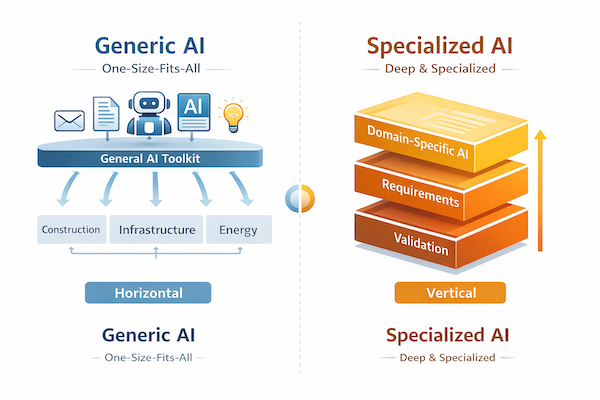
Waiting for a generic Copilot to handle core technical processes is a risky strategy. In the world of Systems Engineering, “almost right” is simply not good enough. A general‑purpose AI usually lacks a deep understanding of the strict context of INCOSE guidelines and the ISO‑15288 principles.
Where generic models tend toward creative interpretation (hallucinations), a multibillion project demands complete predictability and consistency. Without that domain‑specific depth, teams continue to struggle with fragmented information spread across PDFs, spreadsheets, and emails.
3 | De meetbare prijs van afwachten
While organizations continue to wait and see, the costs keep rising. Inefficient document management and poor data quality generate billions each year in rework and control activities. The numbers make clear how urgent the need for specialization is:
- Employees now spend an average of 18% of their time just searching for information.
- Manual verification slows down decision‑making and increases the risk of errors when changes need to be made quickly.
- 56% of investors have already increased their AI budgets, meaning that laggards are rapidly losing competitive ground.
4 | Why specialization wins: The power of Basewise
Specialized AI for requirements management does not act as a generic assistant, but as a precision instrument. It delivers advantages that a general‑purpose tool simply cannot (yet) match:
- Structural Quality: AI automatically structures requirements according to industry standards and detects inconsistencies or duplicates that humans often overlook.
- Immediate Returns: Validated figures show that specialized AI delivers 10–35% efficiency gains and reduces engineering hours by up to 30%.
- Governance & Security: Unlike public models, specialized solutions protect data ownership and privacy by not creating training data from customer input.
5 | Conclusion: From postponement to targeted action
The sector is approaching a tipping point. Waiting for the “big players” creates a false sense of security, while real progress lies in digitalizing the core now: requirements management. By choosing a specialized approach, organizations lay a robust foundation for planning and risk management that generic tools simply cannot match.
Would you like to see how Basewise.ai truly bridges the “Last Mile” in your projects? Let’s launch a pilot focused on one specific, time‑consuming bottleneck in your current projects, so the value becomes immediately visible.
Start with a pilot
Prevent multimillion‑euro projects from getting stuck in generic tools. Let’s prove the impact of specialized AI by tackling one concrete bottleneck in your current projects.
.png?width=919&height=338&name=BASEWISE.AI%20THEME%20(23).png "BASEWISE.AI THEME (23)")
.png)